Half-Day Retreat Notes - Playing Characters
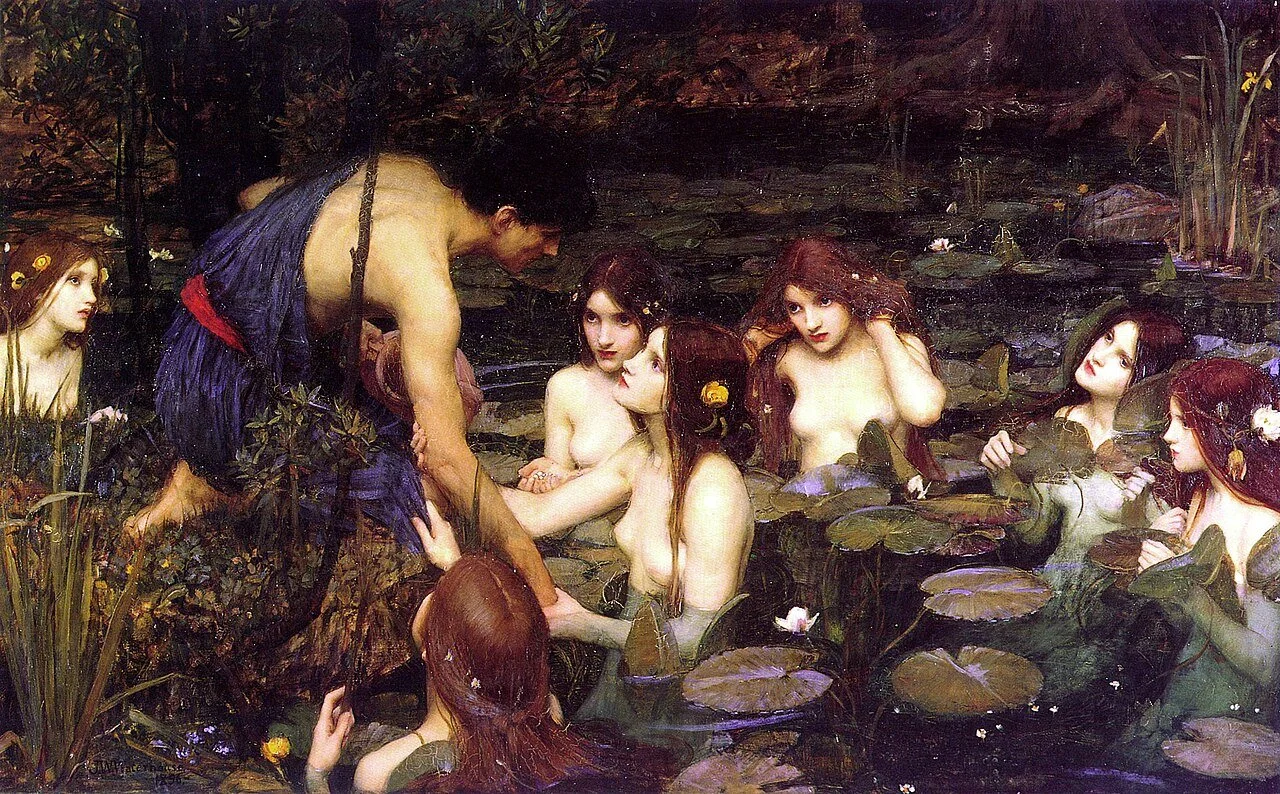
Hylas and the Nymphs, John William Waterhouse
Two weeks ago, I joined a half-day meditation retreat at the Dharma Bum Temple. I am trying to return to a deeper meditation practice, with the goal of attending a ten-day retreat at some point. I want to ease myself back into it gradually so it does not feel as disruptive as I imagine it might right now.
During the retreat, I was mostly practicing concentration, or Samatha, trying to cultivate a sense of stability, even if only from moment to moment.
A few interesting things happened. At times, I began to stretch numbers in my mind, extending them across the duration of my inhalations and exhalations, as if trying to synchronize breath and count. Eventually, the numbers shifted into vivid visualizations. Each number seemed to contain itself repeated within its own structure, with the same number appearing many times inside itself, almost like a recursive pattern where each output includes the previous one with additional layers.
Another captivating experience that arose during the meditation involved visualizing and almost “listening” to people I know responding to questions or opinions within different scenes. I do not remember the specific details. It was less like active internal verbal thinking and more like sudden, unintentional visualizations. They were not connected to a conscious effort in the moment, but appeared on their own, almost like fragments of random movie scenes playing.
What felt particularly striking was the sense of an “aha!” moment that would arise from these scenes. The insight did not come through my usual process of thinking or reasoning, but instead seemed to emerge directly from the experience itself. It felt less like thinking something through and more like a scene, then insight.
The “aha!” moment was the realization: “I am playing characters right now.” Back in February, I wrote Reflections on the Self and the Unified Experience, and how we perceive phenomena as continuous and self-identical over time. That line of thinking eventually led me to consider what I now see as a collapse between subject and object, something I did not write about then but have been reflecting on since.
In this view, the subject, the experiencer, and the object, whether an idea, something material, or whatever is held in attention, are not separate. They arise together within experience.
This resonates not only philosophically but also at an empirical and psychological level. Strong negative emotions toward someone often end up harming oneself. On one level, this is tied to the chemical processes triggered by emotions like anger or rage. But beyond that, if the object, meaning the conception of it, is shaped by perception, experience, and mind, then the object of attention exists within the system itself. Any energy or attention directed toward it reverberates within that same system.
To be clear, this is not a claim of idealism or solipsism. I am not denying the existence of material or physical phenomena. I am referring specifically to the conception of the object as it appears in experience.
After sitting with these ideas for a few weeks and intentionally avoiding research, in order to honor the creative process, I decided it was time to expand my understanding.
My exploration led me to concepts such as Pratītyasamutpāda, commonly translated as dependent origination or dependent arising, and also to the work of Edmund Husserl, particularly his notion of intentionality. This last idea felt especially refreshing and is the one that has captivated me the most at the moment.
At its core, the idea is that consciousness is always about something. Every experience has what Husserl calls an intentional object. The object is not simply something “out there”; it is the object as it is experienced or intended. The implication is that there is no pure subject or pure object in isolation. They are given together within experience.
Husserl describes this structure in two parts. The act, or noesis, refers to the experiencing itself, such as perceiving, judging, or imagining. The object as experienced, or noema, refers to the thing as it appears within that experience.
Example: imagining a friend
𓆉 imagining a friend speaking
𓆉 not the actual person, the person as experienced
𓆉 tone, words, and expression are part of how it appears, noema
𓆉 The act of imagining, recalling, and anticipating is the experiencing, noesis
𓆉 both arise together
𓆉 no independent object in the experience
I think the insight “I am playing characters right now” can be understood through the lens of intentionality. Each “character” is not something external or independently existing, but an intentional object arising within experience. When I imagine someone responding, what is present is not the person themselves, but the person as experienced, shaped by memory, perception, and interpretation.
At the same time, I am not trying to diminish the utility of these kinds of mental simulations. There are critical situations in which such anticipatory processes can be life-saving, such as detecting threats, and more broadly, they align with frameworks like predictive processing in neuroscience.
Rather, this is an observation of how experience organizes itself. It reveals the mind’s tendency to anticipate, and in practical terms, it creates space between mental reactivity and response.
This leads me to question how many characters I am playing in my life, what triggers them, and whether they are useful in reducing suffering and increasing well-being.
Ok, enough notes for today.

Lately
